
The purpose of the SFOM™ Blueprint is to provide a practical map of how modern finance creates value. It clarifies how the ten components interact, where value is generated, and how finance converts information into decisions that influence enterprise performance.
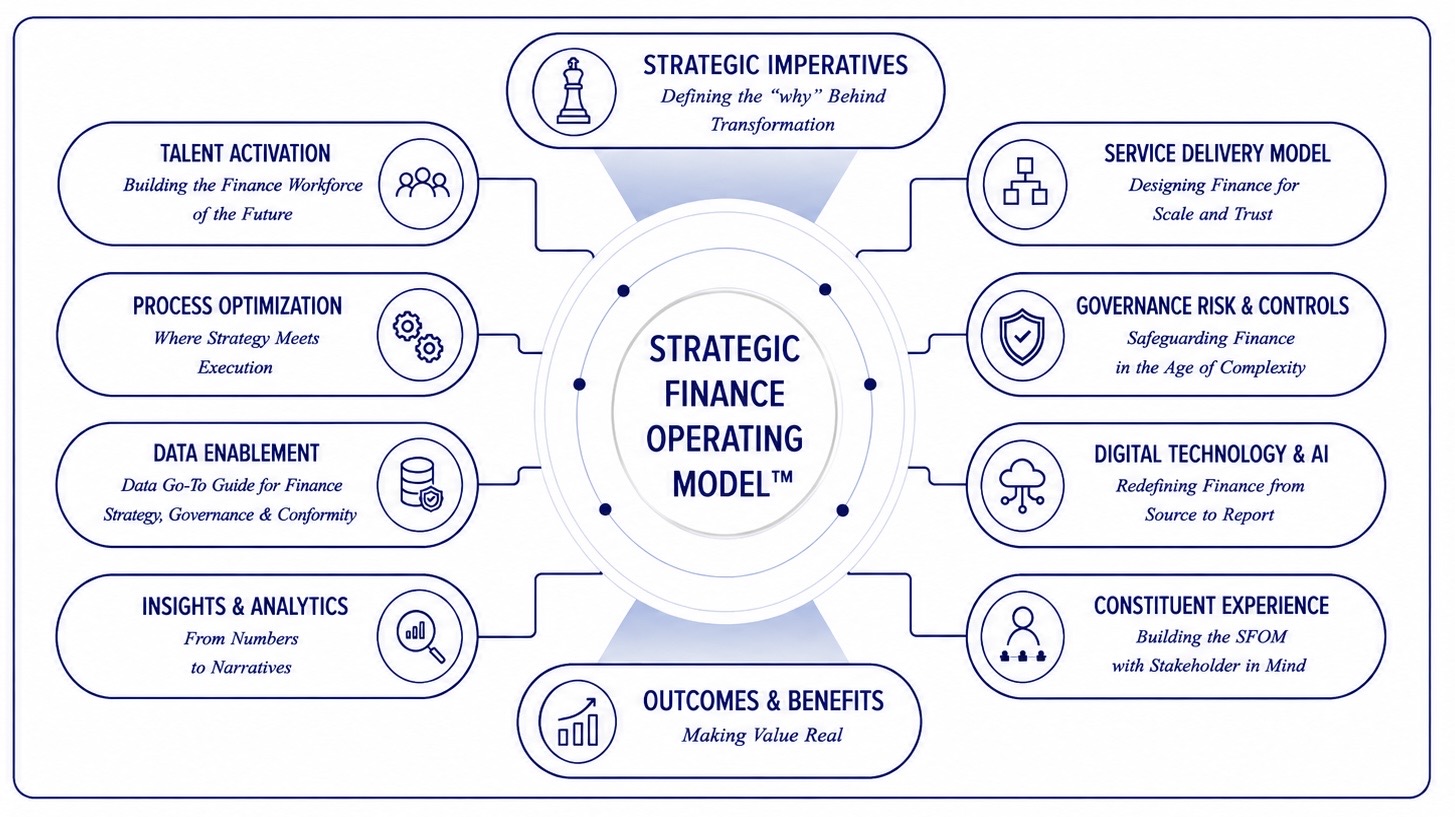
At its core, The Strategic Finance Operating Model™ (SFOM™) is a holistic design tool. It allows CFOs to step above the noise of daily operations and ask the most important question a finance leader can ask:
How should finance really work?
Not how it works today. Not how the ERP vendor says it should work. How it must work to create enterprise value, guide decisions, and operate with speed, coherence, and trust.
The SFOM™ provides a comprehensive view of the finance function across ten interconnected components - ranging from strategy and talent to processes, digital technology, AI, data, governance, and ultimately, the outcomes finance must deliver.
These components do not operate independently. They reinforce one another. A change in one inevitably creates ripple effects in the others. That is precisely why incremental changes rarely succeed. Modernization requires integrated design.
When it is used effectively, the SFOM becomes the mechanism that connects ambition to execution. It helps organizations assess where they are today, define where they need to go, and understand the gaps, trade-offs, and investments required to bridge the distance. It brings structure to complexity, clarity to fragmentation, and coherence to change.
Most importantly, it creates a shared language across finance and the enterprise - something that is sorely missing in many organizations. Without a model, every team has its own version of “how finance works.” The SFOM™ unifies those definitions and aligns the entire function around a single architecture.
How the Ten Components Fit Together as a System
Strategic Imperatives define the purpose and direction of the model. Talent Activation builds the capabilities and behaviors required to execute it. The Service Delivery Model determines where and how work is performed. Process Optimization turns strategy into disciplined execution. Governance, Risk & Controls establish trust. Data Enablement provides the foundation for insight. Digital Technology & AI accelerate scale, speed, and intelligence. Insights & Analytics translate information into action. Constituent Experience ensures finance serves its stakeholders effectively. Outcomes & Benefits measure whether the model creates value.
Why the SFOM™ Blueprint Succeeds Where Other Frameworks Fail
The SFOM™ succeeds because it treats finance as an integrated system rather than a collection of independent initiatives. It aligns strategy, talent, process, governance, data, digital technology, AI, analytics, and stakeholder needs within a single operating architecture.
The Blueprint as the Bridge to Maturity
Understanding the SFOM™ Blueprint naturally leads to the next question: Where are we today? No organization begins at the same level of maturity across all ten components. Some excel in insight but lag in data. Others have strong governance but weak service delivery. Still others operate with modern tools but outdated processes.
Each component of the SFOM™ is supported by a repository of the latest Leading to Lagging practices. They are presented in Four Stages of Finance Maturity, as follows:
Stage 1: Transactional - Finance operates as a set of localized, largely manual processes. Roles are defined narrowly around task execution. Data is inconsistent, technology is fragmented, and business partners receive reporting but not insight. Controls exist but vary sharply by region or business unit. In this stage, finance is essential - but not strategic.
Stage 2: Efficient - The function begins to formalize. Processes are standardized, major workflows are documented, and automation emerges. Shared services may take root. Data definitions begin to stabilize, and digital tools supplement manual work. Finance can scale and perform reliably - but its influence remains limited to reporting what has happened.
Stage 3: Insight-Driven - This is the inflection point where finance becomes a navigator rather than a historian. Predictive analytics, integrated planning, scenario modeling, and unified reporting platforms create a forward-looking view of performance. Talent shifts toward advisory roles. Data becomes trustworthy. Technology becomes an enabler, not a constraint. Finance and the business begin to operate with one shared truth.
Stage 4: Strategic - Finance is fully embedded in enterprise decision-making. Insight is predictive, real-time, and tied to strategic outcomes. Controls are preventative and automated. AI augments planning, analysis, and forecasting. The service delivery model operates globally with centers of excellence. Stakeholder experience is seamless. Finance becomes a catalyst of growth, resilience, and transformation - not a reporter of the past.
This is why the maturity model is essential. It provides the diagnostic lens through which CFOs can assess their current operating model, articulate future ambition, and sequence transformation in an intentional, realistic way. The SFOM™ Blueprint defines the system. The maturity model reveals the starting point. With the SFOM™ Blueprint established, the next step is assessing the current state of that system through the Finance Maturity Model. That assessment will determine not only where finance stands today, but how quickly and effectively it can evolve into the strategic value engine the enterprise requires.

.png)